
Safeguarding of Vulnerable Adults
Concerning rise in reports of abuse against vulnerable adults

Featured Posts

Bishops seek focus on cost-of-living crisis
10 February, 2026
Light will win: Joining in remembrance
22 January, 2026
Invitation for Community Participation in new Governance Structure
23 December, 2025For he rescues the needy who calls to him, and the poor who has no one to help. He has pity on the weak and the needy, and saves the needy from death. From oppression and violence he redeems their lives, their blood is precious in his sight. (Psalm 72:12-14)
It is scripture to care for those who are marginalised. The Catholic Church has renewed and reimagined its commitment to the safeguarding of vulnerable adults and the Catholic Diocese of Maitland-Newcastle is committed to being a ‘safeguarding Church’ in all its parishes and faith communities, schools, early education centres and social services.
The Office of Safeguarding (OoSG) hosts the biannual in service Promoters of Safeguarding Network Days as an opportunity for our parish promoters of safeguarding to network and receive some professional development to support their vital work in locally promoting safeguarding in our faith communities. The OoSG has been privileged to work with a group of dedicated parish staff and volunteers over the years. In the second Promoters of Safeguarding Network Day for 2025 Ben Orman, solicitor for the NSW Seniors Rights Service provided a detailed presentation on Abuse of the Older Person which was highly informative and very well received.
The NSW Aging and Disabilities Commission (ADC) was established on 1 July 2019. The ADC’s purpose is to:
- raise community awareness to reduce and prevent abuse, neglect and exploitation of older people and adults with disability
- receive and respond to reports or allegations of abuse, neglect and exploitation of an older person or adult with a disability
- provide support and information to those at need
- run an investigation (if required) in relation to the conduct of family and informal supports to the older person or adult with a disability
- report and advise the government on related systemic issues.
Recent statistics reported by the ADC suggest that the training we are providing our promoters of safeguarding is becoming increasingly important. There is compelling statistical evidence that churches, indeed the whole community, give greater focus to preventing the increasing rates of abuse of vulnerable adults. The statistical data and graphs presented in this article are taken from the ADC’s Data Report 2024-25.
Increasing Rates of Reporting Alleged Abuse to the ADC
In the six years the ADC has operated there has been a 155% increase in the number of statutory reports it has received (under section 13 of the Ageing and Disability Commissioner Act 2019). In 2024-25 the ADC received 5,864 reports, of which 78% (4,586) related to older people, with 22% (1,278) involved adults with disability. The following graph shows the ADC reporting rates by month and year from July 2019 to June 2025:

More Women than Men are Subject of Reports to the ADC
As with many forms of abuse and control in our society, older women are disproportionately more likely to suffer abuse compared to men. In 2024-25 the ADC received reports involving older women at a rate of almost 2:1 compared to men. The largest proportion of the reports about older people related to the 80-84 years age group (19.9%). More older women were subject of report than men in all ten age groups. The following graph shows the distribution of reports made to the ADC about older people for 2024-25 broken down by age and gender:

There were slightly more females with disability subject of report (55%) compared to men (45%). In six of the ten age groups more women were reported than men. The following graph shows the distribution of reports made to the ADC about adults with disability for 2024-25 broken down by age and gender:

Types of Abuse Reported to the ADC
Of the 5,864 reports received by the ADC in 2024-25 that related to older people, there were 7,133 individual allegations made. Equally, of the 1,278 reports received that related to adults with disability, there were 2,110 individual allegations made. Many of the reports included multiple allegations. The following table sets out the numbers and (percentages) of the five principle forms of abuse committed on vulnerable adults:
| Type of alleged abuse | Older People | Adults with Disability | ||
| No. | % | No. | % | |
| Psychological abuse
(Mainly making excessive or degrading demands; verbal abuse; and preventing/restricting access to supports/services) |
2,635 | 36.9% | 749 | 35.5% |
| Financial abuse
(Mainly financial exploitation; theft; and preventing access to/withholding Person’s money) |
2,186 | 30.6% | 436 | 20.7% |
| Neglect
(Mainly failure to meet support needs; and medical care) |
1,656 | 23.2% | 535 | 25.4% |
| Physical abuse
(Mainly hitting/kicking/punching; and perceived threat of harm) |
569 | 8.0% | 277 | 13.1% |
| Sexual abuse
(Mainly sexual touching; and sexual assault) |
29 | 0.4% | 83 | 3.9% |
| Other | 58 | 0.8% | 30 | 1.4% |
The Hunter has the Highest Numbers of Reports to the ADC
Of great concern is the regional breakdown in the reporting statistics for the ADC. The Hunter Region has the highest number of reports in total and individually for reports on older people and adults with disability, accounting for 11% (519) of the reports. Over the previous six years, ADC annual data reports show that of the sixteen regions in NSW, the Hunter has consistently generated the largest number of reports. In 2019-20, the difference in reporting rates for the Hunter compared to the next region with the largest number of reports (South East Sydney) was virtually nothing (+2). However, year on year the reporting rate in the Hunter has accelerated at a rate greater than other regions in the state, so that in 2024-25 the difference between the Hunter and the next region (South West Sydney) is marked (+130). The difference in reporting rates is of even greater significance when it is recognised that there are a number of regions with larger populations than the Hunter. The following graph shows the 2024-25 ADC reporting rates broken down by region by older people and adults with disability:

Relationship of the Alleged Abuser to the Vulnerable Adult
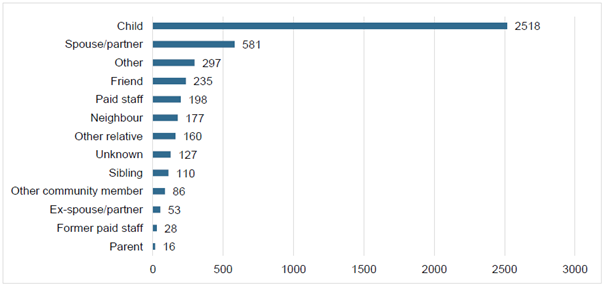
Sadly, as with child abuse statistics, it is most often an immediate family member who poses the most significant risk to a vulnerable adult. Of the 5,864 reports received by the ADC in 2024-25 that related to older people, relatives were the alleged abusers 61.1% of the time. The single largest group of alleged abusers (54.9%) were the adult children of the older people. The following graph shows the relationship of the alleged abuser to the older person reported to the ADC 2024-25:
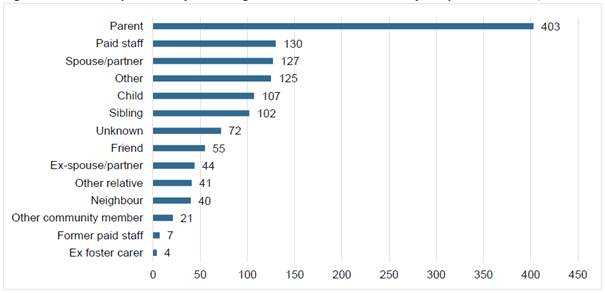
Of the 1,278 reports received by the ADC in 2024-25 that related to adults with disability, relatives were the alleged abusers 51.1% of the time. The adult with disability’s parents were the single largest group of alleged abusers (31.5%). The following graph shows the relationship of the alleged abuser to the adult with disability reported to the ADC 2024-25:
Sadly Christmas-New Year is one of the busiest times of the year for those who work to care and protect vulnerable adults. Family stressors can increase and those who are frail aged and dependent suffer the consequences of these stressors more than others. In this season our Saviour was born, perhaps we should worry less about receiving trinkets of mammon and focus on giving gifts of the Spirit, being a caring presence for those in our lives who are more vulnerable and alone than others.
Then he said to his host, ‘When you give a lunch or a dinner, do not invite your friends or your brothers or your relations or rich neighbours, in case they invite you back and so repay you. No; when you have a party, invite the poor, the crippled, the lame, the blind; then you will be blessed, for they have no means to repay you and so you will be repaid when the upright rise again.’ (Luke 14:12-14)